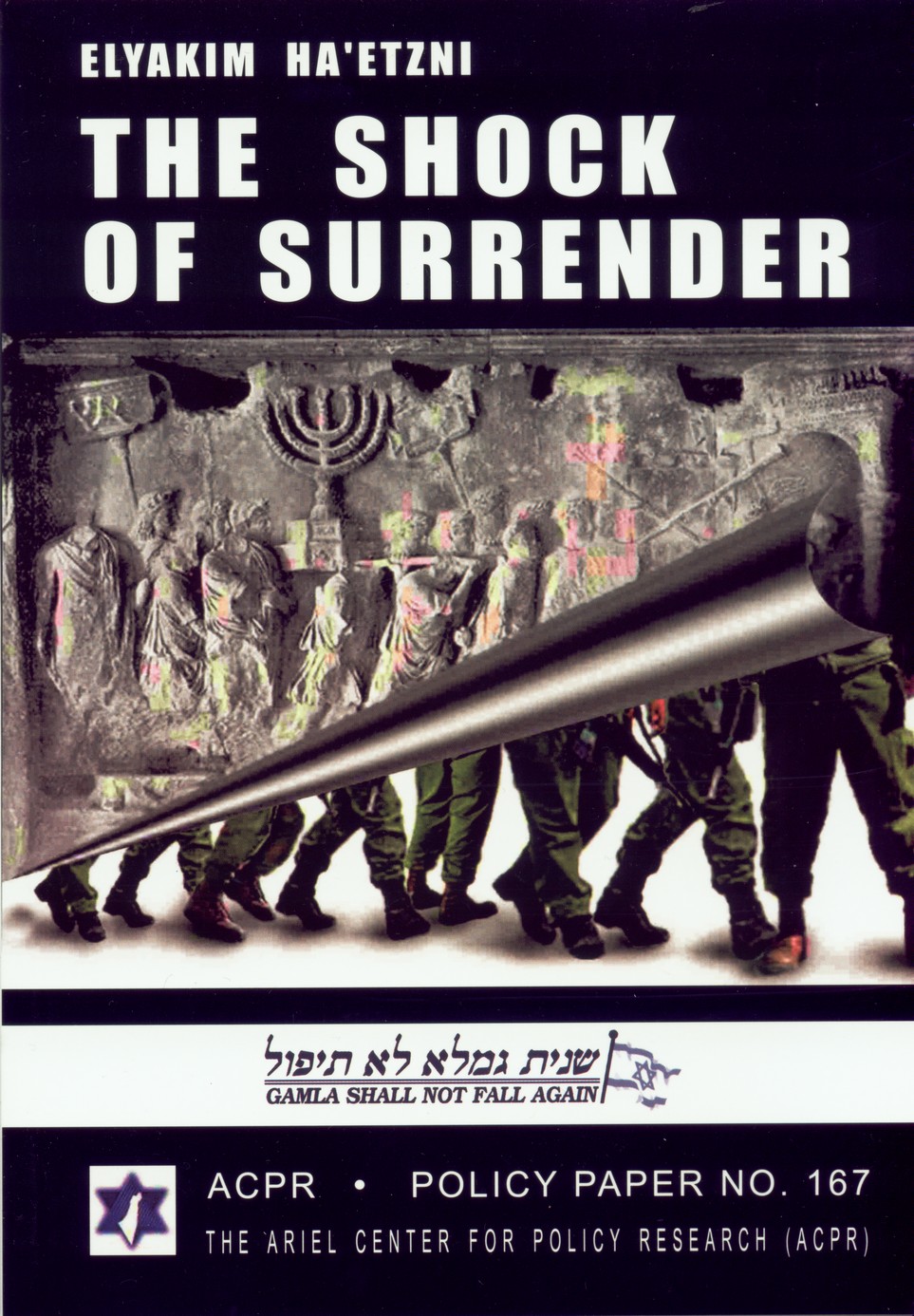
In “The Shock of Surrender”, Elyakim
Haetzni tackles a glaring omission. In the 40-year public debate that has
raged in Israel over the fate of the Biblical territories conquered in the Six
Day War, every aspect of the issue has been microscopically analyzed except
for the most essential one: the effect of abdicating our right to the Land of
Israel on the ancient soul of Israel and on its modern avatar of Zionism.
“The voluntary surrender of East
Jerusalem, Judea, Samaria, and Gaza,” argues Haetzni, “is a mortal wound to
the heart of Zionism, the miraculous modern fruit of 2,000 years of Jewish
yearning and striving.”
Can it be that the Jewish state was
created after millennia of longing for return, only to enable its official
representatives to renounce any Jewish right to the Biblical heartland, and to
destroy and re-exile its resurrected and thriving Jewish communities?
How will we continue to teach our
children the stirring words of the prophets as the life force of our faith,
once leaders of no faith have turned the Bible from a prophecy fulfilled to a
prophecy proven false?
Haetzni asks these and other deeply
fundamental questions, but also takes his exploration onto the harder and
firmer ground of the juridical basis of the Jewish state. He outlines the
“unwritten constitution” that modern Israel rests upon, and traces ways in
which this unwritten constitution was tacitly and explicitly incorporated into
the Israeli legal system.
Haetzni also looks at the human rights
and international law ramifications of expelling Jews from their homes and
destroying their communities. He examines the justifications for the policy of
expulsion that are brought in the name of democracy by examining the issues of
majority versus minority rights and foundational human rights in the western
democratic tradition. He moves from theory to actuality by comparing the
situation in Israel with modern historical analogues.
Haetzni’s prose is careful and reasoned,
but the existential meaning of Israel’s current path that it exposes is truly
shocking.
For the complete text of this paper
(in Hebrew), click here.
For the complete text of this paper
(in English), click here.